Senin, 28 September 2015

The zebra finch

Taeniopygia guttata -Bird Kingdom, Niagara Falls, Ontario, Canada -pair-8a.jpg
A pair at Bird Kingdom, Niagara Falls, Ontario, Canada

The zebra finch (Taeniopygia guttata /formerly Poephila guttata), is the most common estrildid finch of Central Australia and ranges over most of the continent, avoiding only the cool moist south and some areas of the tropical far north. It can also be found natively in Indonesia and East Timor. The bird has been introduced to Puerto Rico, Portugal, Brazil and the United States.

Origin
Origin and phylogeny has been obtained by Antonio Arnaiz-Villena et al. Estrildinae may have originated in India and dispersed thereafter (towards Africa and Pacific Ocean habitats).
 
Male in Western Australia, Australia

Habitat
Zebra finches inhabit a wide range of grasslands and forests, usually close to water. They are typically found in open steppes with scattered bushes and trees, but have adapted to human disturbances, taking advantage of human-made watering holes and large patches of deforested land. Zebra finches — including many human-bred variants to the species — are widely kept by genetic researchers, breeding hobbyists and pet owners.

The zebra finch breeds after substantial rains in its native habitat, which can occur at any time of the year. Birds in captivity are ready to breed year-round. Wild birds are adaptable and varied in their nesting habits, with nests being found in cavities, scrub, low trees, bushes, on the ground, in termite hills, rabbit burrows, nests of other birds, and in the cracks, crevices, and ledges of human structures. Outside of the breeding time, brood nests are constructed for sleeping in.

Zebra finches are distributed over much of Australia and the Lesser Sunda Islands (Nusa Tenggara), which are north-west of Australia.

Life cycle
The life expectancy of a zebra finch is highly variable because of genetic and environmental factors. The zebra finch may reach up to five years in its natural environment. If they are kept caged, they normally live for 5 to 9 years but may live as long as 12 years, with an exceptional case of 14.5 years reported for a caged specimen. The greatest threats to zebra finch survival are predation by cats and loss of natural food.

Subspecies
The two subspecies are:

Taeniopygia guttata guttata, the Timor zebra finch, extends from Lombok in the Lesser Sunda Islands or Nusa Tenggara in Indonesia to Sermata, in addition to coastal areas around the continent of Australia.
Taeniopygia guttata castanotis is found over the wide range of continental Australia.

The Australian race is sometimes split as chestnut-eared finch (Gould, 1837), Taeniopygia castanotis.

The morphological differences between the subspecies include differences in size. T. g. guttata is smaller than T. g. castanotis. In addition, the T.g. guttata males do not have the fine barring found on the throat and upper breast of T.g. castanotis, as well as having small breast bands.

Song and other vocalizationsZebra finches are loud and boisterous singers. Their calls can be a loud beep, meep, oi! or a-ha!. Their song is a few small beeps, leading up to a rhythmic song of varying complexity in males. Each male's song is different, although birds of the same bloodline will exhibit similarities, and all finches will overlay their own uniqueness onto a common rhythmic framework. Sons generally learn the song of their fathers with little variation. Songs may change during puberty, but afterwards they are locked in for the life of the bird. Scientific research at Japan's RIKEN institute has suggested that singing to females is an emotionally rewarding experience for male zebra finches.

Male zebra finches begin to sing at puberty, while females lack a singing ability. This is due to a developmental difference, where in the embryo, the male zebra finch produces estrogen, which is transformed into a testosterone-like hormone in the brain, which in turn leads to the development of the nervous system for a song system. Their songs begin as a few disjointed sounds, but as they experiment, they match what they sing to the memory of their fathers' song, and they rapidly mature into full-fledged songs. During these formative times, they will incorporate sounds from their surroundings into their songs, also using the songs of other nearby males for inspiration.

Male finches use their songs, in part, as a mating call. The mating act is usually accompanied by a high-pitched whining sound. They will also exhibit a hissing sound when protecting their territories.

Because zebra finch males learn their songs from their surroundings, they are often used as avian model organisms to investigate the neural bases of learning, memory, and sensorimotor integration. The zebra finch genome was the second bird genome to be sequenced, in 2008, after that of the chicken. Their popularity as model organisms is also related to their prolific breeding, an adaptation to their usually dry environment. This ability also makes them popular as pet songbirds.

Diet
Zebra finches, like most estrildid finches, are primarily seed-eating birds, as their beaks are adapted for dehusking small seeds. They prefer millet, but will consume many other kinds of seeds, as well. While they prefer seeds, captives will also eat egg food. They also readily consume fresh foods, such as small bits of chopped lettuce, apples, and grapes. They are particularly fond of spray millet, and one or two of these small birds will eat a spray millet stalk within a few days. Zebra finches are messy and voracious eaters, typically dropping seeds everywhere. This behaviour spreads seed around, aiding in plant reproduction. The availability of water is important to this bird's survival, therefore the zebra finch will drink often when water is available and enjoys taking bird baths in a small, shallow bowl. A typical zebra finch may be plump, because it eats quite often throughout the day, but an overweight bird needs more exercise, not less food. Finches should always have access to fresh food and water.
  
Captive male                                     Captive female
Breeding
In the zebra finch, sudden bursts of gathering behaviours signal that a pair is ready to nest. The pair will pull strings or plant leaves they can reach, and if no materials are available to gather, they will use feathers and bits of seed husks. Alfalfa or timothy hay is an acceptable nesting material, as it is closest to what is readily available in the wild. Any item they can use to build a nest will be deposited in a corner of the cage floor, or in their food dish. When these behaviours are noticed, a mating pair should be provided with a sturdy wicker nest about the size of a large apple or orange. This nest should always be placed in the highest possible corner of the cage, opposite the food dish, but near the normal night perch. Nesting finches will abandon a perch if it is across the cage, with the male showing he prefers to sit atop the nest while the female lays. During the nest building, however, both will spend the night cuddling inside the nest.

When they accept the nest shell and begin using it each night, they should be provided with an ample supply of very soft bits of short string and leaves. They prefer items only a couple of inches long and will use nearly any type and colour of soft material; longer bits of string or nesting material can tangle around the finches or nestlings and cause distress that will lead to strangulation or even death. The nest shell will be packed with everything they can reach for at least a week before laying begins.

The number of eggs ranges from two to seven eggs per clutch, with five being the most common number. In captivity, some birds lay larger clutches.

Males and females are very similar in size, but are easily distinguished from one another, as the males usually have bright orange cheek feathers, red beaks (as opposed to the orange beaks of females), and generally more striking black and white patterns. The beak is sometimes the only way to tell the gender of a zebra finch, as sometimes the orange cheek colouring is faded or non-existent. However, the orange cheeks are a stubborn indication that a young zebra finch is indeed a male and the cheeks begin to appear when the young are about two months old. Young zebra finches will also have black beaks, with the colouring coming in at puberty, though it begins changing at age one month.

The chicks will hatch according to the laying time of each egg. It is common to have one or two eggs remaining unhatched as the parents begin the task of feeding the nestlings. Though it is preferable to leave nests alone after the egg-laying begins, once hatching begins, a breeder might find it useful to make daily checks into the nest to correct problems early, such as larger chicks sitting on and smothering smaller ones, thus increasing the number of chicks that eventually fledge. The time from laying until a fledgling adventures outside will vary with each clutch, but generally good eggs will hatch within 14 to 16 days of laying and young will begin to venture out within about three or four weeks of hatching, and will look full-grown in about three months. Breeding age is six or more months. Zebra finches are usually excellent parents and will readily take turns sitting on the nest and bringing food to the young.

While the female is laying, only her mate will be allowed in the nest. Allowing the pair to start a new family while the first clutch is still in the cage will overly stress all the birds in the family. The male of the breeding pair will not allow any other birds near the nest while eggs are being laid. It is advised that fully weaned birds from the previous clutch be removed and placed into a separate enclosure to prevent aggressive actions of the adult male who will likely try to beat up younger birds which are seen as competition for the female's attention.

The Gouldian finch

 Male adult Gouldian Finch.jpg
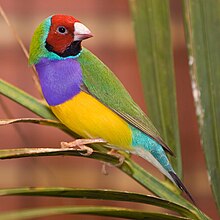
Adult red-headed male

The Gouldian finch (Erythrura gouldiae), also known as the Lady Gouldian finch, Gould's finch or the rainbow finch, is a colourful passerine bird endemic to Australia. There is strong evidence of a continuing decline, even at the best-known site near Katherine in the Northern Territory. Large numbers are bred in captivity, particularly in Australia. In the state of South Australia, National Parks & Wildlife Department permit returns in the late 1990s showed that over 13,000 Gouldian finches were being kept by aviculturists. If extrapolated to an Australia-wide figure this would result in a total of over 100,000 birds. In 1992, it was classified as "endangered in the wild" under IUCN's criteria C2ai. This was because the viable population size was estimated to be less than 2,500 mature individuals, no permanent subpopulation was known to contain more than 250 mature individuals, and that a continuing decline was observed in the number of mature individuals. It is currently subject to a conservation program.
 
Red headed male Gouldian finch at Artis Zoo, Netherlands

Taxonomy
The Gouldian finch was described by British ornithological artist John Gould in 1844 and named after his wife Elizabeth. It is also known in America as the rainbow finch, Gould's finch, or the Lady Gouldian finch (although Mrs. Gould did not hold the title lady). In Australia, it is predominantly called the Gouldian finch. It is a member of the weaver-finch family Estrildidae, which is sometimes considered a subfamily of Passeridae.

Origin
Origin and phylogeny has been obtained by Antonio Arnaiz-Villena et al. Estrildinae may have originated in India and dispersed thereafter (towards Africa and Pacific Ocean habitats).

Description
Both sexes are brightly coloured with black, green, yellow, and red markings. The females tend to be less brightly coloured. One major difference between the sexes is that the male's chest is purple, while the female's is a lighter mauve.

Gouldian finches are about 130–140 mm long. Gouldian finches' heads may be red, black, or yellow. Formerly considered three different kinds of finches, it is now known that these are colour variants that exist in the wild. Selective breeding has also developed mutations (blue, yellow and silver instead of a green back) in both body and breast colour.

Juveniles also have distinctive colours. Their heads, sides and necks are grey, and their backs, wings and tail feathers are olive green. Their undersides are pale brown. Beaks are blackish with a reddish tip. Their legs and feet are light brown. Newly hatched Gouldian finches are pink and naked until about 12 days old when the beginnings of feathers start to appear. Very young birds, like many other species of Australian cavity-nesting finches, have a variety of odd features in and around their mouths including a "palate marked in the fashion of a domino" and several "prominent rounded tubercles" with an "opalescent lustre" at the back of the gape. These tubercles are commonly (and incorrectly) described as phosphorescent in spite of much scientific evidence to the contrary. It is believed that these tubercles simply reflect light and are not luminescent. Scientists have hypothesized that this domino-like palate and striking tubercles may facilitate feeding within the dark confines of a nest cavity, although no experiments have been conducted to support this idea.
 
A young Gouldian finch

Distribution and habitat
These birds are found in northern Australia, from the Cape York Peninsula through north-west Queensland and the northern Northern Territory to the Kimberley region of Western Australia. Their habitat is tropical savannah woodlands. The birds are nomadic within a relatively small area (approximately 40 square kilometres) and only move when water or food becomes scarce. The largest known wild population of the species is found in the Bastion Hills, next to the town of Wyndham in the eastern Kimberley, where a 28 km2 site – the Wyndham Important Bird Area – has been identified by BirdLife International.

Prior to the Australian government's ban on the export of Australian fauna in 1959, Gouldian finches were exported worldwide. These birds have resulted in viable breeding populations being held in many countries.

Captive breeding has resulted in several colour mutations to the back and two mutations to the breast. Mutations vary by country, with some existing only in Australia (the Australian yellow and the Australian "dilute") and others existing in greater number in the United States, such as the blue bodied Gouldian. The most common body mutations in the United States are blue, pastel green (single and double-factor, resulting in "dilute" and yellow males and yellow females), and pastel blue (again, single and double-factor producing "pastel" and silver males, and silver hens). There is also a lutino and albino mutation in the United States, established by Winnie McAlpin of Delmar Aviaries.

Conservation status
The number of Gouldian finches has decreased quite dramatically during the 20th century. Their habitat has been reduced or altered. Early research indicated a parasite called the air sac mite was responsible for the decline of the species. This is no longer considered to be a major factor. In general, Gouldian finches are susceptible to diseases and viral infections. Their beautiful colours mean that they are easily caught by predators. Fires are listed as the primary threat to the natural populations. The total number of Gouldian finches altogether is not low, however, because they are among the most popular pet birds, and are bred in captivity for the pet trade.

Recovery plans are in place to recover and conserve its natural habitats, such as building protective fencing to prevent damage by cattle, research on wildfires and their effects on Gouldian population and constructing artificial nest boxes in order to provide more nesting locations for wild pairs. Attempts at reintroduction have so far proved unsuccessful. It was also suggested to develop management guidelines for land-holders about appropriate land management, promoting the recovery program, and Gouldian finch conservation.

Behaviour
Although often bred in a colony in captivity, in the wild, the Gouldian is not a colony bird. Outside the breeding season, however, Gouldian finches often join mixed flocks consisting of long-tailed finches and masked finches. This is probably a defense against predation. Flocks used to consist of up to 1,000–2,000 individuals. During the breeding season they are usually found on rough scree slopes where vegetation is sparse. In the dry season, they are more nomadic and will move to wherever there is food and water.

Feeding
Like other finches, the Gouldian finch is a seed eater. During the breeding season, Gouldian finches feed mostly on ripe or half-ripe grass seeds of sorghum. During the dry season, they forage on the ground for fallen seed. During the wet season, spinifex grass seed (Triodia sp.) is an important component of their diet. So far Gouldians have been recorded as consuming six different species of grass seed, but during crop analysis, researchers have yet to find evidence of insect consumption.

Breeding
Gouldian finches generally make their nests in tree-holes, generally within a kilometer or so of water. They usually breed in the early part of the dry season, when there is plenty of food around. The male courtship dance is a fascinating spectacle. When a male is courting a female, he bobs about ruffling his feathers to show off his colors. He expands his chest and fluffs out his forehead feathers. After mating, a female lays a clutch of about 4–8 eggs. Both parents help brood the eggs during the daytime, and the female stays on the eggs at night. When the eggs hatch, both parents help care for the young. Gouldian finches leave the nest at between 19 and 23 days and are independent at 40 days old.

Gouldian finches have brightly coloured gapes and call loudly when the parent birds return so that they are able to find and feed their mouths in the dark nest.

Young Gouldians are very fragile until their final moult. Some breeders believe parent-raised Gouldians have greater success rearing young than those fostered by other species, such as Society finches or spice finches.

It has been shown scientifically that female finches from Northern Australia are controlling the sex of their offspring, according to the head color of their male counterpart. The finding, published in the journal Science, is one of the first to clearly show that birds are capable of biasing the sex of their offspring to overcome genetic weaknesses. This has also been reported in the ABC television scientific program Catalyst.Lead author Dr Sarah Pryke, of the Department of Brain Behaviour and Evolution at Macquarie University in Sydney, admits the mechanism by which the birds do this is not yet known.

The Gouldian finch (Erythrura gouldiae), which is found in the northern savannahs of Australia, can have black, red or orange heads. Pryke says some genetic incompatibility between the black and red-headed birds results in high mortality in the offspring when birds of different head colours mate. With female offspring this mortality rate can be as much as 80% higher than in a same-head colour pairing. Sons in a mixed pairing have a 40% mortality rate. Pryke found that if the female mates with a finch of different head colour, she attempts to overcome this genetic incompatibility by over-producing sons – as much as four males to one female. "This jis the first time such a large effect has been shown," says Pryke. "It is actually the female that is controlling the gender." To reach this conclusion Pryke and colleague Simon Griffith took 100 red-headed and 100 black-headed female birds and mated them with a male of the same head colour and a male with the different head colour. They found females in mixed pairs produced broods that were 82.1% male, whereas females in matched pairs produced an unbiased sex ratio with 45.9% males. They then tested whether the females in mixed pairs were deliberately over-producing sons. In captivity the female finches often need worming, this is a common thing with all female finches. Female birds were tricked into thinking they were mating with an incompatible male. The researchers did this by temporarily blackening the head colour of red males and mating them with red and black-headed females. The black females paired to red males with blackened heads produced a sex ratio that was roughly equal. By contrast, red females paired with red males that had blackened heads over-produced sons at a ratio similar to a mixed pairing. Pryke says there is no chemical or genetic interaction between the parents at work. "Gouldian finches wear their genes on their head so it is easy for a female to assess the genetic suitability of the male," she says. "Change the colour of the male's head with dye and the sex ratio changes." Through the study the researchers also found that females from mixed pairs produced fewer and smaller eggs. Pryke says the finding is important because up to 30% of breeding pairs in the wild are mixed "perhaps because of constraints on preferred mate availability".

Professor Ben Sheldon, director of the University of Oxford's Edward Grey Institute of Field Ornithology, says the results demonstrate "hitherto unsuspected degrees of control over reproductive investment by female birds". "This work opens new possibilities in unravelling the mechanisms behind these striking behaviours, something which has up to now remained an unsolved mystery," he says.

Aviculture
Gouldian finches are a popular species in aviculture due to their bright colors, low maintenance, and relative easy breeding. A high-quality finch seed blend, fresh clean water daily, and grit mixture (soluble and insoluble) are components of an everyday diet that should be considered along with fresh dark leafy greens (Kale, Collards, Chard) and egg-food or soft-food offered two to three times a week when not breeding, and daily while breeding.

They are a colony bird, so it is not recommended to keep them alone, and they get along well with other species of grass finch as well as other docile species such as waxbills and parrot finches, though one should exercise caution when housing the latter two together as they will hybridize.

Trapping for aviculture
In the Kimberley District of Western Australia, where most wild Gouldian Finch were trapped for aviculture, it was often reported as one of the more common of the eleven finch species. Until 1977, it was trapped in greater numbers than any other finch. From 1897, when finch trapping started in the Kimberley, it was the most sought after finch by trappers and the most desired by fanciers. Between the years 1934 and 1939, the Gouldian Finch was the most exported single finch species. The Perth Zoo exported 22,064 finches of which 12,509 were Gouldian. Private dealers exported 35,315 finches, of which 14,504 were Gouldian. The number of finches taken in the 1958 finch trapping season was the largest for one year, of the 38,649 finches taken, 11,286 were Gouldian. The last licensed trapping of Gouldian Finch in Western Australia was on 15 November 1981. In that year's finch trapping season, of the 23,450 finches taken 1,054 were Gouldian.

The British finch


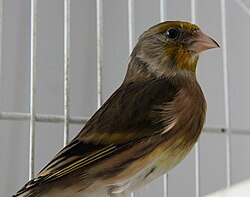
The British finches are made up of several species of finch which were formerly very popular as cage birds in Great Britain. They are not currently commonplace, but are still kept by a few dedicated fanciers.

History
In Victorian times British finches were hugely popular as cage birds throughout the British Isles, often replacing canaries. Due to a lack of protection, thousands of birds were captured for the pet trade every year.

Their popularity is reflected in the well-known British music hall song, "My Old Man (Said Follow the Van)", in the line, "I walked behind wiv me old cock linnet..." referring to the linnet (Carduelis cannabina).

Regulation
British finches are often associated with mules, a term used by cage bird breeders to refer to hybrids of finch species bred in captivity, such as that of a goldfinch and canary. There are now strict ringing regulations on British finches in places such as the UK, but they are still kept by aviculturists who care for them in much the same way as canaries. The seed mixture in the UK known as British Finch & Mule is their basic diet.

Since the Wildlife and Countryside Act 1981, it has been illegal to capture, attempt to capture or sell any British bird, and only those on Schedule 3 Part 1, may be sold if they are closed ringed and proof can be given that they were bred in captivity.

Species
British finches are quite simply birds in the finch family which to this day live wild in the British Isles.
The species most popular include:

Genus Fringilla - bramblings and chaffinches
Common chaffinch (Fringilla coelebs)
Brambling (Fringilla montifringilla) (Note: this species is often known in aviculture as the bramble finch)

Genus Carduelis - linnets, redpolls, goldfinches, greenfinches, some siskins
Greenfinch (Carduelis chloris)
Redpoll (Carduelis species)
Siskin (Carduelis spinus)
Goldfinch (Carduelis carduelis )
Twite (Carduelis flavirostris)
Linnet (Carduelis cannabina)

Genus Loxia - crossbills
Common crossbill (Loxia species) (Note: In Victorian times the Scottish crossbill had not been identified)

Genus Pyrrhula - bullfinches
        Eurasian bullfinch (Pyrrhula pyrrhula)
A hybrid between a European goldfinch and a domestic canary

Mules and hybrids
During the Victorian era, it was found that if a British finch, e.g. a goldfinch, was crossed with a canary, the result was an attractive looking, good singing bird. The resulting birds were sterile, but continue to be bred to this day under the name of mules. Many clubs specialise in mules.
Also around this time a few people began to experiment crossing British finches. The resulting birds, including siskin × goldfinch and even such beauties as crossbill × Eurasian bullfinch also remain to this day, often winning prizes at prestigious shows. The breeding of such hybrids can, however be notoriously difficult. When writing about hybrid pairs, the cock always comes first, e.g. greenfinch × goldfinch is a greenfinch cock over a goldfinch hen.

The society finch

Rbruni.JPG

The society finch (North America) or Bengalese finch (elsewhere), Lonchura striata domestica or L. domestica, is a popular cage bird not found in the wild.

Evolution
It is a member of the estrildid finch family. Many authorities call it a domestic form of the white-rumped munia (known in aviculture as the striated finch), at least probably, though some state that it originated as a hybrid of this species with others in the genus Lonchura. A DNA study found that it was more closely related to the white-rumped munia than either bird is to the zebra finch, the chestnut-breasted munia, or the "Silver Bill" (presumably the Indian silverbill), indicating that it originated from the white-rumped. 

Behavior
Bengalese finches are well adapted to captivity and the company of humans. They breed well and are good foster parents for other finch-like birds.
While two males may not get along without other company, it has been found the best "pairing" for fostering is to use two males, this works better than either two females or a male and female pairing. Two males will usually accept eggs, or even partly grown young without any hesitation.

These birds like to be close together and tend to all roost in one nest if kept in a group. In an aviary they lay eggs and crowd into a single nest, interfering with incubation (which is performed by the female and lasts 16 days) or damaging the eggs. Thus they breed better if kept as single pairs in individual breeding boxes.This sociability is also responsible for their American name of "society finch".

Bengalese finches are quite easy to look after. They are also quite easy to breed provided they are properly sexed. Obtaining a female-male pair can present a difficulty because both sexes look similar. However, it is possible to determine gender by behavior since males tend to display to females. One method to sex Bengalese is to place a single bird in a small cage completely isolated it from its own kind (both sight and hearing) and after several hours then introduce another Bengalese to the cage. If the first bird is a male it will immediately display to the newcomer. Unfortunately this does not necessarily mean the introduced bird is a female. But if the first bird does not display it is almost certainly a hen. 

Diet
They are generally given a diet of seeds, such as millets and canary seed, and greens.They will not usually take live-foods, but it has been found they will often accept housefly pupae, which they crack like seeds. This is particularly useful if they are being used to foster species that require a high protein component to be successfully reared.

The European goldfinch

 Carcar.jpg
In Tarn, France

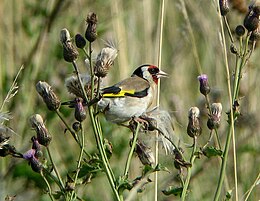
The European goldfinch or goldfinch (Carduelis carduelis), is a small passerine bird in the finch family that is native to Europe, North Africa and western Asia. It has been introduced to other areas including Australia, New Zealand and Uruguay.

The goldfinch has a red face and a black-and-white head. The back and flanks are buff or chestnut brown. The black wings have a broad yellow bar. The tail is black and the rump is white. The female is very similar to the male but has a slightly smaller red area on the face.
The goldfinch is often depicted in Italian renaissance paintings of the Madonna and Child.

Taxonomy
The goldfinch was described and illustrated by Swiss naturalist Conrad Gesner in his Historiae animalium of 1555. In 1758 Linnaeus included the species in the 10th edition of his Systema Naturae under its current binomial name, Carduelis carduelis. Carduelis is the classical Latin word for a goldfinch.[5] Modern molecular genetic studies have shown that the European goldfinch is most closely related to the citril finch, (Carduelis citrinella) and the Corsican finch, (Carduelis corsicana).

The English word 'goldfinch' was used in the second half of the 14th century by Geoffrey Chaucer in his unfinished The Cook's Tale: "Gaillard he was as goldfynch in the shawe (Gaily dressed he was as is a goldfinch in the woods)".

Subspecies
The subspecies are divided into two major groups. These intergrade at their boundary so the groups are not recognised as distinct species despite their readily distinguishable plumage. Subspecies in the carduelis group occupy the western part of the range and have black crowns; subspecies in the caniceps group occupy the eastern part of the range and have grey heads.

carduelis group

    C. c. balcanica Sachtleben, 1919 – southeastern European
    C. c. brevirostris Zarudny, 1890 – Crimea, north Caucasus
    C. c. britannica (Hartert, 1903) – British Isles
    C. c. carduelis (Linnaeus, 1758) – most of European mainland, Scandinavia
    C. c. colchica Koudashev, 1915 – Crimea and northern Caucasus
    C. c. frigoris Wolters, 1953 – western Siberia
    C. c. niediecki Reichenow, 1907 – southwest Asia, northeast Africa
    C. c. parva Tschusi, 1901 – Atlantic Macaronesic Islands (Canary I., Madeira), Iberia, northwest Africa.
    C. c. tschusii Arrigoni degli Oddi, 1902 – Corsica, Sardinia, Sicily
    C. c. volgensis Buturlin, 1906 – southern Ukraine, southwestern Russia and northwestern Kazakhstan

caniceps group

    C. c. caniceps Vigors, 1831 – southern central Asia.
    C. c. paropanisi Kollibay, 1910 – Afghanistan to western Himalaya and Tien Shan.
    C. c. subulata (Gloger, 1833) – south-central Siberia.
    C. c. ultima Koelz, 1949 – southern Iran

Description
The average goldfinch is 12–13 cm long with a wingspan of 21–25 cm and a weight of 14 to 19 grams. The sexes are broadly similar, with a red face, black and white head, warm brown upperparts, white underparts with buff flanks and breast patches, and black and yellow wings.

On closer inspection male goldfinches can often be distinguished by a larger, darker red mask that extends just behind the eye. In females, the red face does not extend past the eye. The ivory-coloured bill is long and pointed, and the tail is forked. Goldfinches in breeding condition have a white bill, with a greyish or blackish mark at the tip for the rest of the year. Juveniles have a plain head and a greyer back but are unmistakable due to the yellow wing stripe. Birds in central Asia (caniceps group) have a plain grey head behind the red face, lacking the black and white head pattern of European and western Asian birds.

The song is a pleasant silvery twittering. The call is a melodic tickeLIT, and the song is a pleasant tinkling medley of trills and twitters, but always including the trisyllabic call phrase or a teLLIT-teLLIT-teLLIT.
 
Two C. c. caniceps in Tabo, Himachal Pradesh

Distribution and habitat
The goldfinch is native to Europe, North Africa, and western and central Asia. It is found in open, partially wooded lowlands and is a resident in the milder west of its range, but migrates from colder regions. It will also make local movements, even in the west, to escape bad weather. It has been introduced to many areas of the world. It was introduced to Canada, United States, Mexico, Peru, Argentina, Chile, the Falkland Islands, Uruguay, Brazil, South Africa, Australia, and New Zealand, in the 19th century, and their populations quickly increased and their range expanded greatly. They now occur from Brisbane to the Eyre Peninsula in Australia, and throughout New Zealand.

Behaviour and ecology
Breeding
The nest is built entirely by the female and is generally completed within a week. The male accompanies the female but does not contribute. The nest is neat and compact and is generally located several meters above the ground, hidden by leaves in the twigs at the end of a swaying branch. It is constructed of mosses and lichens and lined with plant down such as that from thistles. It is attached to the twigs of the tree with spider silk. A deep cup prevents the loss of eggs in windy weather. Beginning within a couple of day after the completion of the nest, the eggs are laid in early morning at daily intervals. The clutch is typically 4-6 eggs which are whitish with reddish-brown speckles. They have a smooth surface and are slightly glossy. The average size is 17.3 mm × 13.0 mm (0.68 in × 0.51 in) with a calculated weight of 1.53 g (0.054 oz). The eggs are incubated for 11-13 days by the female who is fed by the male. The chicks are fed by both parents. Initially they receive a mixture of seeds and insects but as they grow the proportion of insect material decreases. For the first 7-9 days the young are brooded by the female. The nestlings fledge 13-18 days after hatching. The young birds are fed by both parents for a further 7-9 days. The parents typically raise two brood each year and occasionally three.

Feeding
The goldfinch's preferred food is small seeds such as those from thistles (the Latin name is from Carduus, a genus of thistles) and teasels, but insects are also taken when feeding young. It also regularly visits bird feeders in winter. In the winter goldfinches group together to form flocks of up to forty, occasionally more. Goldfinches are attracted to back gardens in Europe and North America by birdfeeders containing niger (commercially described as nyjer) seed. This seed of an annual from South Asia is small, and high in oils. Special polycarbonate feeders with small oval slits at which the goldfinches feed are sometimes used.

Relationships with humans
Goldfinches are commonly kept and bred in captivity around the world because of their distinctive appearance and pleasant song. In Britain during the 19th century many thousands of goldfinches were trapped each year to be sold as cage-birds. One of the earliest campaigns of the Society for the Protection of Birds was directed against this trade. The goldfinch males are sometimes crossed with Canary females with the intention to produce male mules with beautiful singing voices, that often capture the best singing attributes of both breeds.

Christian symbolism
Because of the thistle seeds it eats, in Christian symbolism the goldfinch is associated with Christ's Passion and his crown of thorns. The goldfinch, appearing in pictures of the Madonna and Christ child, represents the foreknowledge Jesus and Mary had of the Crucifixion. Examples include the Madonna del cardellino or Madonna of the Goldfinch, painted by the Italian renaissance artist Raphael in about 1505–6, in which John the Baptist offers the goldfinch to Christ in warning of his future. In Barocci's Holy Family a goldfinch is held in the hand of John the Baptist who holds it high out of reach of an interested cat. In Cima da Conegliano's Madonna and Child, a goldfinch flutters in the hand of the Christ child. It is also an emblem of endurance, fruitfulness, and persistence. Because it symbolizes the Passion, the goldfinch is considered a "saviour" bird and may be pictured with the common fly (which represents sin and disease). The goldfinch is also associated with Saint Jerome and appears in some depictions of him.

Depictions in art
Antonio Vivaldi composed a Concerto in D major for Flute "Il Gardellino" (RV 428, Op. 10 No. 3), where the singing of the goldfinch is imitated by a flute.

Goldfinches, with their "wanton freak" and "yellow flutterings", are among the many natural "luxuries" that delight the speaker of John Keats's poem 'I stood tip-toe upon a little hill...' (1816).
In the poem The Great Hunger by Patrick Kavanagh, the goldfinch is one of the rare glimpses of beauty in the life of an elderly Irish farmer:

The goldfinches on the railway paling were worth looking at
A man might imagine then
Himself in Brazil and these birds the birds of paradise

Donna Tartt's novel The Goldfinch won the 2013 Pulitzer Prize for Fiction. A turning point in the plot occurs when the narrator, Theo, sees his mother's favourite painting, Carel Fabritius's The Goldfinch, in the Metropolitan Museum of Art.